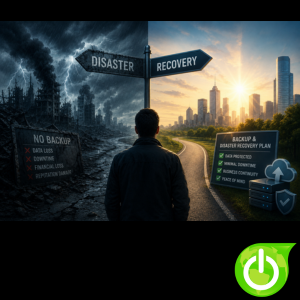
 As a small business owner, it is easiest to think of the difference in terms of your assets versus your operations.
Backup: Saving Your Stuff
Backup is simply making a copy of your data. Think of it like a digital filing cabinet or a spare set of keys.
The Scenario: An employee accidentally deletes an important invoice, or a laptop gets stolen.
The Fix: You go to your backup, grab a copy of that specific file, and put it back.
The Catch: Backups only protect your data. They do not protect your time. If your office floods, having a digital copy of your files does you no good if your staff has no computers to work on.
Disaster Recovery: Saving Your Operations
Disaster Recovery (DR) is your business continuity plan. It is the blueprint for how your company keeps making money when everything goes wrong.
The Scenario: A hacker locks down your entire network with ransomware, or a power surge fries your main server room. Your business is completely dead in the water.
The Fix: A DR plan kicks in. It automatically flips a switch to move your team to a temporary “cloned” network in the cloud. Your employees can log in from home and keep working as if nothing happened.
The Focus: DR is all about speed. It ensures your business doesn’t lose thousands of dollars per hour in downtime.
The Bottom Line
Backup answers the question: “Is our data safe?”
Disaster Recovery answers the question: “How fast can we get back to work and start making money again if everything crashes?”
You need backups to build a disaster recovery plan, but relying only on backups is like having a spare tire but no jack—you’re still stuck on the side of the road.