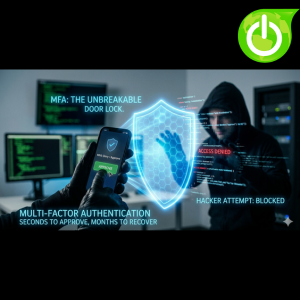
 Think of your business accounts like your physical office. Right now, your passwords are like cheap, standard door locks. Here is the problem: hackers have master keys. They steal millions of passwords every day through data leaks and phishing scams.
If a hacker gets your password, they can lock you out of your business, steal your revenue, or access your clients’ private data.
The easiest, cheapest insurance policy against this is Multi-Factor Authentication (MFA).
MFA adds a second lock to your digital doors, one that requires a completely different key. To log in, you need two things:
- Something you know: Your password.
- Something you have: Your physical smartphone.
When you turn MFA on, a hacker who steals your password still gets stopped dead in their tracks. When they try to log in, the system will say, “Great, you have the password. Now type in the temporary code we just texted to the owner’s cell phone.”
Unless that hacker is sitting in your office holding your physical phone, they cannot get in. The attack fails instantly.
The Threats and Why It’s a No-Brainer for Business
Automated Hacks. Cybercriminals use software to guess thousands of passwords a second. Software cannot physically grab your phone to bypass MFA.
Phishing Emails. If an employee accidentally gives away their password to a fake website, the hacker still can’t log in without the employee’s phone.
Big tech companies like Microsoft and Google have tracked this data across millions of businesses. The verdict? MFA blocks over 99% of automated account takeovers.
Turning on MFA in your email, banking, and software settings takes five minutes, usually costs nothing, and prevents the kind of data breach that forces small businesses to close their doors forever. It is the single highest-return security investment you can make.