
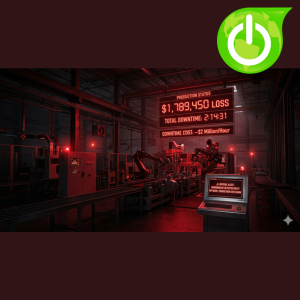
 For decades, the manufacturing world was worried about physical safety, machine maintenance, and supply chain logistics. But in 2026, the biggest threat to the assembly line isn’t a broken gear or a late shipment, it’s a line of malicious code.
Manufacturing has officially claimed the title of the most-targeted industry for cyberattacks. It’s no longer a matter of if a factory will be hit, but when. Hackers have realized that manufacturers are the perfect “golden goose” for one simple reason: they cannot afford to stop moving.
The Ransomware Trap: Why You?
Cybercriminals aren’t just bored teenagers in basements; they are sophisticated “ransomware gangs” operating like corporations. They target manufacturing because of low downtime tolerance.
If a social media site goes down for an hour, people complain on Twittysical machinery on the floor. This is how digital bits and bytes turn into physical damage and shutdowns.
The 2025-2026 Wake-Up Caller. If a manufacturing plant goes down for an hour, the losses are catastrophic. We are talking about $50,000 to $2 million per hour in lost revenue, wasted materials, and missed delivery deadlines.
Hackers know that the pressure to get back online is so immense that many companies will simply pay the ransom to make the problem go away. This “pay-to-play” cycle has turned the industry into a primary ATM for global cybercrime.
The Achilles’ Heel: Legacy Systems
The biggest challenge for any factory is the “Legacy System.” In many plants, you’ll find machines that have been running reliably for 20 or 30 years. These machines were built to last, but they weren’t built to be connected to the internet.
As we push toward “Industry 4.0″—using AI and IoT (the Internet of Things) to make factories smarter—we are connecting these old, unpatchable machines to the web. These legacy systems are full of security holes. They often run on outdated software that doesn’t receive security updates, making them an easy “back door” for any hacker looking to get inside.
The “Blurring Lines” of IT and OT
In the past, the “office” (Information Technology or IT) and the “factory floor” (Operational Technology or OT) were completely separate. The computers used for emails didn’t talk to the robots building the cars.
Today, those lines have blurred. To get real-time data on production, we’ve bridged the gap between IT and OT. While this is great for efficiency, it’s a nightmare for security. An attacker can now start by sending a phishing email to an accountant in the office, move through the company network, and eventually take control of the ph
The numbers from the past year are staggering. Manufacturing was the top-targeted sector for the fifth year in a row, with incidents jumping by 33%. We saw this play out in high-profile breaches at Nucor and a massive, headline-grabbing shutdown at Jaguar Land Rover. These weren’t just data leaks; they were total operational halts that cost millions and shook investor confidence.
How to Build a Digital Fortress
So, how does a modern manufacturer protect themselves without going back to the Stone Age? It requires a shift in mindset: cybersecurity is now a core part of production.
- Microsegmentation (The “Firewall” Strategy): Imagine your factory is a ship. If one compartment hits an iceberg, you shut the doors so the whole ship doesn’t sink. Network segmentation does this for your data. It ensures that a hack in the office doesn’t automatically mean a hack on the assembly line.
- Integrating IT and OT Security: You can no longer have two different teams. Your security strategy must be holistic, covering everything from the server room to the welding robot.
- The Human Factor: Most hacks don’t start with a “super-hacker” typing fast; they start with an employee clicking a link they shouldn’t have. Regular, “dumbed-down” training for every staff member—from the CEO to the forklift driver—is the best defense you have.
- Continuous Monitoring: You wouldn’t leave your factory doors unlocked at night without a security guard or a camera. Digital monitoring works the same way. You need tools that watch your network 24/7 to catch weird behavior before it turns into a total shutdown.
The Bottom Line
In 2026, a secure factory is a profitable factory. If you treat cybersecurity as an “IT problem” rather than a “business survival problem,” you are leaving your doors wide open. It’s time to stop thinking of cyber-defense as an expense and start seeing it as the ultimate insurance policy for your production line.
Is your operation truly protected, or are you just one bad click away from a $2 million-per-hour mistake? Contact us today so we can assist you with making sure your business is properly protected.