
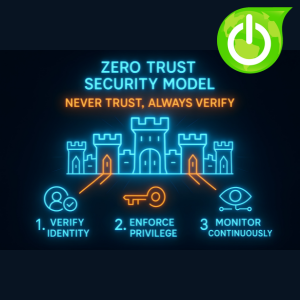
 Picture your office building for a moment. The front door is locked. Visitors check in. Maybe there’s even a badge system or biometric scanner. But once someone is inside, are they free to roam wherever they want—into the finance office, the server room, or HR files?
Of course not. Security measures are in place for each area that contains important or sensitive company data.
Yet for years, many business networks worked the opposite way. Once a user logged in, they were effectively “inside,” and broad access followed. That model was built for a time when employees worked in one location and data stayed on local servers.
That world is gone.
The Zero Trust security model starts from a simple but powerful assumption: trust itself is a risk. Instead of assuming anything inside the network is safe, Zero Trust verifies every access request—every user, every device, every time.
And while Zero Trust used to sound like something only large enterprises could afford, that’s no longer the case.
Why Traditional Network Security Falls Short Today
Legacy security models rely on a strong perimeter—firewalls, VPNs, and the idea that threats live “outside” the network. The problem? Most modern attacks don’t break in. They log in.
Stolen credentials, phishing emails, compromised devices, and insider threats routinely bypass perimeter defenses. Once attackers are inside, they can move laterally, exploring systems and escalating privileges with little resistance.
Zero Trust changes the rules. It treats every request as untrusted until proven otherwise. Instead of protecting a location, it protects individual resources—applications, data, and systems—wherever they live.
This shift directly addresses how attacks actually happen today, especially credential-based attacks that continue to dominate breach reports year after year.
The Core Principles Behind Zero Trust
Zero Trust isn’t a single product. It’s a framework built on clear, enforceable principles. From a CTS perspective, two stand out as especially impactful for small and mid-sized organizations.
Least Privilege Access
Users and systems should only have the access they absolutely need—nothing more, nothing permanent.
Your marketing team doesn’t need finance data. A line-of-business application shouldn’t talk to every workstation on the network. And elevated access should be temporary, not standing.
Least privilege dramatically reduces blast radius. If credentials are compromised, attackers hit a wall instead of an open floor plan.
Micro-Segmentation
Micro-segmentation divides your network into smaller, isolated zones. Each segment has its own access rules, preventing threats from spreading freely.
If a guest Wi‑Fi network is compromised, that breach should stop there—not jump to servers, accounting systems, or point-of-sale devices. Segmentation contains damage, limits downtime, and buys you time to respond.
Practical Zero Trust Steps for Growing Businesses
Zero Trust doesn’t require an incredible amount of resources. CTS recommends starting where risk is highest and expanding over time.
1. Identify your most valuable data. Customer information, financial records, operational systems, and intellectual property should be protected first. Map where that data lives and who truly needs access.
2. Enforce multi-factor authentication everywhere. MFA is one of the most effective security controls available. It ensures that a stolen password alone isn’t enough to gain access—an essential component of Zero Trust.
3. Separate critical systems from general access. Use dedicated, secured networks for core business systems. Guest Wi‑Fi and employee devices should never share unrestricted access to sensitive resources.
Small changes can have significant impact on reducing risk.
Modern Tools That Make Zero Trust Achievable
The shift to cloud services has made Zero Trust far more accessible than it once was.
Identity and access management platforms, such as Microsoft 365 or Google Workspace, include conditional access features that evaluate context before granting entry—location, device health, login behavior, and more.
Secure Access Service Edge (SASE) solutions extend protection directly to users, no matter where they work. These platforms combine networking and security controls in the cloud, reducing reliance on traditional VPNs and perimeter hardware.
Used correctly, these tools deliver enterprise-grade protection without enterprise-level complexity.
Zero Trust Is a Mindset, Not Just a Technology
Implementing Zero Trust isn’t only about tools, it’s also about culture.
Teams may initially push back against extra verification steps. That’s where clear communication matters. When employees understand that these measures protect their work, their data, and the business itself, adoption becomes easier.
CTS strongly recommends:
- Documenting who needs access to what
- Reviewing permissions quarterly
- Updating access immediately when roles change
Ongoing governance keeps Zero Trust effective as your organization evolves.
Your Path Forward with CTS
Zero Trust is not a one-time project. It’s an adaptive strategy that grows with your business and responds to a changing threat landscape. Start with an access and data flow assessment. Enforce MFA across all accounts. Segment your network beginning with your highest-value assets. And fully leverage the security features already included in your cloud environment. The goal isn’t to slow your business down with rigid barriers. Rather, it’s to build smart, flexible controls that protect what matters most without getting in the way.
Contact us today to schedule a Zero Trust readiness assessment and take the first step toward a more resilient security posture.